Showing posts with label Trading Process. Show all posts

Tuesday, August 14, 2012

Trading Process - Step 15


The Trading Process - Review and Monitor - Step 15

However you trade, make sure you review your performance regularly.  Some people do this every day, some every month.  The point, though, is to know where you stand, and once you determine something is seriously statistically wrong, make changes.  Don't wait until your account is empty before you take action, but also don't make changes after the first losing trade.

Have a scheduled "business review" and you'll be better prepared than 90% of traders out there.


Next: That completes the series on "The Trading Process"

Friday, August 3, 2012

Execute Flawlessly


The Trading Process - Execute Flawlessly - Step 14

As traders, we all make mistakes.  We buy instead of sell.  We forget to turn automation on or off.  We don't have backup internet or computer access.  We forget about positions in our account.

The point is that mistakes are part of the business.

One way to get "incentive" to correcting mistakes is to record them, and record the amount of dollars involved. You can easily do this with a spreadsheet.  Just compare your actual fills to your "perfect" fills - the fills you should have obtained if you had executed flawlessly.

You can also use this spreadsheet to account for slippage in stop and market orders.  Many unscrupulous people out there show results without slippage - they obviously aren't trading!

I recently looked at my actual fills versus what Tradestation performance reports said.  I had assumed $35 for commissions and slippage per trade.  When I analyzed my real money results - which include some late trades, mistakes and of course normal bid/ask slippage - I found that my actual commissions and slippage was about $30 per round trip trade.  So, I am doing better than I had expected, and that is great to know.

Sometimes mistakes will work in your favor, and sometimes (most times) they will cost you money.

The key though, is that you can only correct what you know about.  Keeping a record of mistakes is the first step on the road to getting rid of them.

Next: Review and Monitor

Wednesday, August 1, 2012

Overleverage


The Trading Process - Don't Overleverage - Step 13

Probably the biggest mistake I see traders make is with overleveraging.  Basically, their "bet" size is too big for their account.

I realize that many small traders almost have to overleverage (or else not participate at all), but some people mistakenly think if they have a $10,000 account, and day margin is $500, they should trade 20 contracts!

As a trader, your first goal is really just to stay in the game, until you have a proven method.  Until you reach that point, staying small is the way to go.

With any new system I trade, I almost always start with 1 contract.  As profits accumulate, so do the number of contracts I trade.  But, it is a slow process.

So, how do you know if you are overleveraged?  Here are a couple of guidelines:

1.  Risk only 1-2% of your account on any trade.  So, if you have $10,000 account, your max loss should only be $100.  Due to market noise, $100 is very, very small, and maybe you should wait to trade when you have more risk capital.

2.  Your account size should be 2-3 times the initial overnight margin requirement, AT A MINIMUM.  So, for example, Euro currency initial margin is currently $4,050.  If you have $10,000 - $15,0000 account, and trade 1 contract, you MIGHT be OK.

3.  If you go to my website (www.kjtradingsystems.com) and sign up for my e-mail list, I'll send you a link to a Monte Carlo spreadsheet.  Simply enter your trade results and your account value, and you'll see what your risk of ruin and median drawdown over 1 year of trades is likely to be.  If you find your risk of ruin is say 75%, you are overleveraged!

Just remember, it is better at first to trade very small.


Next: Execute Flawlessly

Sunday, July 22, 2012

Trading Process - Step 12


The Trading Process - Follow The Plan - Step 12

I see comments like these everyday, especially in many of the retail trader blogs:
"I had a losing day today, so I think I need to add a filter..."
"After 4 consecutive losses, I have to go back and re-test..."
"Starting today, my plan is now that I will double my position after a loss, to recover more quickly..."


Maybe you've even said one of the above.  All of them spell Trouble.  With a capital T.

The lesson is simple:  Once you have a well thought out, well researched plan, STICK TO THE PLAN!


Next: Don't Overleverage

Saturday, July 14, 2012

Trading Process - Step 11


The Trading Process - Know Your Exit Point - Step 11

One of the most important items in trading is knowing when to quit.  No, I am not talking about any particular trade, and where you should place your stop loss level.  I am talking about when to quit trading a system, strategy or method.

If you want to save your trading capital, it is CRUCIAL that you know when you will stop trading a particular method.

I wrote about this in an article (shown below) for SFO Magazine (which is now defunct, since it was published by PFGBest).

The most important thing I found, which most people do not do, is you need to write it down BEFORE you start trading.

It might be: "I, Kevin Davey, will stop trading XYZ strategy when I encounter a 35% maximum drawdown."

Share this pronouncement with a trading colleague, or your spouse.  This will make you more likely to follow it.

Simply put: Without an exit point for stopping trading, you are likely doomed!


Next: Stick to Your Plan


**************************************************************


Know When to Quit a Trading System
August  2010
By Kevin J. Davey www.kjtradingsystems.com
Text size: A+ a
Congratulations! After a great deal of investigation, you have decided to “go live” with a new trading system. At this point, it is usually easy to determine when to start trading it—as soon as possible! The excitement and anticipation of assumed future profits makes this simple.
The real decision, however, should not be when to start trading the system, but instead when to stop trading it. Unfortunately, most traders never think of this until it is too late.
Why is it important to have a quitting point for a system prior to even starting to trade it?
Before answering that, just to be clear, I am not talking about exits or stop points for any particular trade. That is embedded in the trading system itself. I am talking about ceasing trading on the system itself. And as critical as individual trade exit points are, a system quitting point is probably even more important.
Two key points drive home why it is critical to have a stopping point for any system.
First, protection of capital always has to be your primary goal. Dreams of profits are nice, but preparing for the downside is how most traders stay in the game. Because once your capital is gone, you are out. So you need to have a quitting point that does not ruin you. Even the best systems can go bad, and you should be prepared for that.
Second, in the heat of trading, emotions will run high, especially as losses pile up. A good trader knows that making decisions during this stressful time usually backfires.
Most traders tend to quit at the absolute worst time, probably because they finally have reached the breaking point with the system and threw in the towel.
Having a quitting point written down before trading starts removes the emotion and makes the decision much easier.
Once you are convinced of the need to establish a quitting point for any trading system, the question becomes, what criteria should be used for quitting? Some popular methods—and some unorthodox ones—are discussed here.
MAXIMUM DRAWDOWN
Probably the most popular approach is to base the quitting point on the maximum drawdown (The decline of a financial instrument from the peak price to the trough.). This can be established in dollars or in percentage terms. One problem many people have is they establish this amount based on their personal preferences, which is good, but they do not take history of the system into account, which can be bad.
For example, they might decide to quit after a $10,000 maximum drawdown, which is usually perfectly reasonable. But it is not reasonable if the system’s history shows multiple $10,000 drawdowns, as shown in...
Figure 1.

This might seem obvious, but most people never bother to match the system’s expected drawdown to their personal preferences. Neglecting this is just guaranteeing inevitable failure.
CONSECUTIVE LOSERS
A second popular approach is to quit after a certain number of consecutive losers. In this approach, if the system’s history showed six losses in a row, then if six consecutive losses occur in real time, the system is stopped.
The problem with this method is the randomness of wins and losses could easily lead to more than six losses in a row, depending on the system. Just because six was the longest streak in the past, does not mean it will be the longest streak forever.
PERSONAL OBJECTIVES
One hopes as part of your trading plan, you have listed goals and objectives for any system you trade. For example, your goal might be a 50 percent rate of return with a 25 percent maximum drawdown.
When you picked the system, you thought it would meet your goals, so every six months or so, you should compare your goals to your system. If there is a big divergence, perhaps it is time to stop trading the system—even one that is showing profits.
The key here is that you should have another, better system ready to take its place that also meets your goals.
SYSTEM CHANGE
Whether you are trading your own system, a black box system or following signals of another trader, you should always be on the lookout for drastic changes in the system methodology. For example, if the system history is based on trading the E-mini S&P on the open, and all of a sudden it starts trading in late afternoon, run, don’t walk, from this system.
Or if you find yourself rewriting or tweaking your system rules to show better historical performance, your original strategy is no longer valid. The system is now something different, and you need to stop trading it until you reassess the strategy as if it were brand new.
OTHER APPROACHES
Because the decision to stop is ultimately personal, you can use whatever criteria with which you feel comfortable. A certain amount of money lost in a week or month, or a system winning percentage dropping beneath a certain threshold are two examples.
Basically, if it can be measured and it makes sense to you, then it is a valid criteria to use.
Just as there are standard, simple methods on which you can base your quitting decision, there are also complicated ones.
STATISTICAL PROCESS CONTROL
In manufacturing, the quality of most processes is assured by a technique called statistical process control (SPC). An example SPC-run chart is provided in Figure 2.


In a nutshell, SPC uses knowledge of the process to determine what is normal and what is abnormal. If certain criteria are violated, corrective action (changes to the machine or shutting down the machine) is taken.
This method, although complicated, can be highly effective, as it uses actual trade results to make its decision.
TECHNICAL ANALYSIS OF THE EQUITY CURVE
Many people apply technical analysis to the equity curve of...
the system and trade based on this. An example of this is given in Figure


 3, with a moving average of the equity curve. When the equity is above 


the moving average, the system is turned “on,” and it is turned “off” when


 it is below the moving average.


Although this sounds appealing, two troubling aspects emerge.
First, what length of moving average should be used? Picking the “best” one based on history is just like optimizing a system variable—the best in the past rarely works best going forward.
Second, unless there is trade dependency occurring (if the results of the last trade depend on the trade result right before it), there is no mathematical reason why this method should work.
Other popular technical approaches, such as using breakouts or patterns in the equity curve may work, but they are prone to the same issues, such as overoptimizing or hindsight bias, that make the methods tough to use on price data.
EXIT AT A PEAK
Because most people exit a system after a period of bad performance and the majority ultimately lose, what would happen if you stopped trading a system at a new high? The theory here is that a peak will inevitably be followed by a dip, and at the dip trading can resume.
Psychologically, this method is probably a killer for most traders. Why would one stop trading a system that is doing well, only to pick up when it is doing badly? But it might just work, because it is the opposite of what most people who are losing would do.
PUT IT IN WRITING
By now, you realize the importance of having a quitting point for any system you implement. Additionally, you may have a few more ideas for how to implement one.
The key is that your personal quitting point must be written down before you start trading a system. And, of course, you must follow it.
If you do not establish and record it prior to beginning a trading system, then chances are you will make a rash decision to quit based on the heat of the moment. Or worse, when a quitting point is inevitable, you will bury your head in the sand and continue trading until there is nothing left. As a result, deciding when to quit trading may be the most important decision you make.


Saturday, June 23, 2012

Weekend Update, Step 10

Contest Update

Almost 6 months into the contest, and I'm down 20%.  Not exactly how I had envisioned!  But then again, trading has never been a smooth upward ride for me (and, I suspect, is not that way for most people).

Flat/down periods, followed by quick jumps up, is generally how things go, at least historically.  Of course, this can be mentally draining, since the flat/down periods tend to make you think you are trading incorrectly/poorly.  The markets have a way of breeding indecision, lack of self confidence, impatience, frustration, worry, and a million other bad feelings.  It is quite amazing, actually, at how the market can ruin your psyche.

At this point, I'll continue to ignore those bad feelings -  I'll keep sticking to the Trading Plan, and see where it leads!


************************************


The Trading Process - Incubate - Step 10

In this post, I'll give you a tip that is one of the best things I do.  It is also one of the hardest.  It is called "incubation."

The idea is that once you develop a strategy, following all the correct steps, you don't trade it right away.  You just put the strategy aside for 3-6 months.

Of course, since you just finished the development, you want to start trading it TODAY!  Just think of all those dollars headed out the window, as you let the strategy sit!  That is what makes this step so difficult - no one wants to spend months developing a strategy, only to let it sit for months on end.

BUT, how do you know for sure that you didn't "cheat" while developing the strategy?  How do you know that you used the correct process?

The simple fact is nothing (except for real money trading) beats results with future data, and that's what you get by incubating.

I personally put a strategy aside, and look at it once a month.  If, after 4-6 months, the performance is close to my historical testing, then I may allocate money to it.

Many times, especially when I first started using the incubation process, I weeded out many "bad" strategies.  In some cases, I went back and determined that my strategy development process had some flaws.  Thankfully, incubation hleped me make improvements, without costing me money!

Next: If there is a fire, you better know where the exit is!


Tuesday, June 19, 2012

Step 9 - How To Backtest

Contest Update:

Still underwater (about 10% loss from start).  Still trading exactly as planned (except where initial margin becomes issue).  Still VERY disappointed at the last month of performance.  Still feeling more than a bit depressed and embarrassed at having to show this to the world.

I hope that readers get one takeaway from my current performance: anything can happen in trading.  Historically winning strategies can turn negative (for either a little while, or maybe forever).  Don't position size assuming that you will be profitable - that is trading suicide.


**************************


The Trading Process - Backtest the Right Way - Step 09

Last time we discussed "expectancy."  If your trading approach doesn't have a positive expectancy, DON'T TRADE!  It is critical.

Of course, to get historical trades to determine your trading system expectancy, you must backtest.

You can either backtest by hand, or use trading software to help you.  Backtesting can be very tricky, though.  Here are a few tips to help you backtest properly:

1) Make sure you include realistic costs for commissions and slippage.  I typically use $25-50 per contract per round turn trade.  My numbers are based on actual trading.  Many strategies look great with $0 commissions and/or slippage.  THESE SYSTEMS ARE FANTASY!

2) If you use backtest software, learn the tricks and pitfalls in it.  In Tradestation, for example, the default setting for limit orders will assume a limit order is filled if touched.  Traders know that in most instruments, you'll never get filled on a "touch" of your limit price.

3) Make sure you aren't "peeking" into the future.  This is really easy to do if you backtest by hand or with Excel.  An example of this would be buying today's close if tomorrow's open is up - you can;t know this in advance.

4) If your results look too good to be true, they probably are.  You either done something wrong, optimized your backtest too much, or curve fit rules to match the data.

5) Your backtest should definitely include either a significant out of sample test period, or should use walkforward backtesting.  If you don't know why this is important, make sure you research it and learn.  I guarantee that following this step alone will save you thousands.  Only the inexperienced optimize over all their data, and then start trading.

Obviously, proper backtesting is a huge topic.  I've just scratched the surface.

Next: Incubation, not just for baby chicks any more!


Saturday, June 9, 2012

Positive Expectancy

Contest Update:

Up about 11% for the year (see chart below).  All I can do is follow the plan.  I say that over and over, but it is the best thing I can possibly do. Most people fail when they start to deviate from their plan.  This contest system may still fail, but I know it has historical positive expectancy.  That means it has been profitable in the past.  But, I need to follow the plan to reap the benefits of positive expectancy.


That is a good intro to step 8 in my continuing series of "Developing a Trading System"...


Comments and questions, as always, are encouraged...


Trading Process, Step 08 - Have Positive Expectancy


Many people look at a chart, "see" a few instances of a profitable pattern, and then start trading it.


Other people see a flashy new indicator being sold by someone who probably doesn't even trade.  Every example shown leads to profit.  It is the Holy Grail indicator!


Does either case sound familiar?  Unfortunately, that is what most people do before they trade - they find a few profitable examples that back up their thoughts (and conveniently ignore or hide the losing examples), and then start trading.  That is the wrong way to do it.


The right way to evaluate a strategy, whether you are backtesting or evaluating in real time, is to:


1) Have a statsitcially significant number of trades.  5 or 10 trades is not enough.  You want at least 50, preferably 100's or more.  In my contest account, I had over 500 trades evaluated as part of my research.  In my SFE Trading system (available on my website), I evaluated over 3,000 trades.


2) Have an evaluation period that includes bull markets, bear markets, flat markets.  A month or two of market action is never enough.  You really need years.


3) HAVE A POSITIVE EXPECTANCY SYSTEM.  Here is how to calculate it:
Expectancy = ((Probability of Win * Average Win) – (Probability of Loss * Average Loss))/(-Average Loss)
This number must be positive, ideally 0.2 or higher.  The higher the better, although if it is too high, I'd wonder about overfitting or  over optimizing, or some other backtest error.


If you have all 3 of these items, your chances of success go up a great deal.


Next: How To Backtest


Wednesday, May 23, 2012

Look Out Below!

Contest Update:

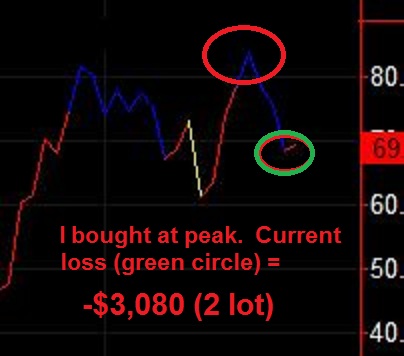
Once again, I have proven quite adept at buying at the high.  I did this last week for the trade signal I missed, and it was a double position, so the total loss right now for this one position stands at -$3,080.  

YES, I AM A GENIUS TRADER!!!! HA HA HA HA


****************************************************************

The Trading Process - Conduct Preliminary Research - Step 07

(Note: to see any of the previous steps, look for the heading "Trading Process" in the column on the right.)

At this point in the process, you should have a decent Trading Plan, and you should realize that you need a trading strategy with an edge to succeed.  So, how do you develop an edge?

Edges are all around us.  They can be as simple as trading in the direction of the prior day's close, or as complicated as a multi node neural network based on 5 uncorrelated instruments.  The trick is actually finding them, and then evaluating them.

My best edges come from simple market observation ("hmmm, it seems like the market moves up after candlestick pattern X"), trading books and magazines and from other traders (it is amazing how successful traders freely share - maybe it is because we all realize how difficult trading really is).  Let your imagination run wild, and your mind will come up with some creative ideas.

A couple points to keep in mind:

1.  No idea is bad, dumb or stupid.  Be non-judgmental in this phase.  Be open to anything.  Your later analysis will weed out the bad ideas.

2.  Make sure it fits you.  If you like trying to pick tops and bottoms, don't develop a long term trend following system.  Remember, these are your ideas, so be comfortable with them.

3.  Ideas in books and magazines rarely work as is.  BUT, they are a great place to start.  You can modify core ideas, and create your own winning strategy.

4.  Make sure you have the right tools.  If you are data mining, make sure you have the right software.  If you are looking for patterns, make sure you have an objective way to define and measure them.

Next: A simple formula to help you "see" good strategies.


Thursday, May 17, 2012

Random Noise

Contest Update

Just bouncing around the 50-55% return mark.  Nothing real exciting (equity curve shown at bottom).


The Trading Process - Step 06 - The Trading Strategy

The last few steps in the Trading Process series have dealt with developing goals and objectives, and putting these in your Trading Plan.  The idea is that once you know what you want, it is much easier to create or find something that meets your goals.  Of course, depending on your objectives, it still may be very difficult to come up with a strategy.  BUT, that is much better than losing money with an ill fitting strategy.

In the next 3 steps, I'll briefly describe how to take an idea, and turn it into a strategy.  Each step alone could be a book in itself, so I'll just give you a high level overview in those steps.

But first, let's backup a step.  At this point, you know what you want to achieve trading.  So, why not just subscribe to a trading newsletter, or watch CNBC and trade off their reports, or lease or buy a "robot," and start trading?  Many people do just that.  I knew one "trader" who based decisions on the color of the financial commentator's ties!  But jumping into trading at this point is a terrible idea.

The bottom line is you want to have confidence in whatever approach you choose.  The only way to get that confidence is objectively evaluate the system's performance in the past (historical backtest) or in real time.  Without one or both of these "tests," you won't know if you have an edge.  And you need an edge to survive.

What I am really saying here?  Basically, when you start trading, you want to be able to shout "I have a trading strategy with a proven edge!  I can make money trading this strategy!"

Next time we'll discuss the preliminary research you need to do to get a trading strategy.


Saturday, May 12, 2012

Still In The Hunt, Trading Process Continued

Contest Update:

Official standings for the contest can always be found here:
http://www.worldcupadvisor.com/worldcupchampionships/default_nwcc2.aspx

Currently, I am in 4th place with 52.7% return.  Equity curve is at the bottom  Right now, I have 7 open positions.  1 good size winner, 3 mid size winners (1 of those is a double position), and 3 small losses.


***********************************************************************
Trading Process, Step 05


The Trading Process - Other Considerations

Last time, I discussed that as part of your Trading Plan, you need to have objectives for any performance metric (win percentage, trading frequency, etc - think about it, and go beyoned the few I've given you) that you think are important.  If you don't you'll either create or buy a system that does not "fit" you.  And doing that almost always leads to disaster.

Besides the strategy (which we will discuss next time)and its performance parameters (which I've already described), it is critical for you to figure out some other things, BEFORE TRADING.  Here is a partial list:

Platform - what trading platform will you use?  Does it come with historical data, charts, backtest capabilities?  If it is an order platform, does it send orders directly to exchange, or does it hold oders on the platform's server?  Have you spent time practicing with it, so under pressure you don't mix up buying and selling, mix up limit orders and stop orders?

Time - do you have the time to spend 1) actually trading and 2) researching new trading strategies?  If your approach requires you to check your computer every hour, can you do that?  When I had a full time job, I made sure all my strategies could be run end of day.  Don't buy an off the shelf system before figuring this out.  Again, it is all about "fit" - the system has to match your time constraints.

This list could go on and on, but I hope you see my point - think about all this BEFORE you even start trading!

Next time: The Actual Trading Strategy


Monday, May 7, 2012

Trading Process, Continued

Contest

Down a wee bit today.  What I like is that for the past week or two, my equity has not had any wild swings.  Probably because my initial margin to equity ratio is only about 30%.  I've been as high as 100%, a few months ago.  Slow and steady up is my preferred mode, but the market doesn't give a hoot what I like!

Here is step 4 in the "DEVELOPING A TRADING SYSTEM " Trading Process Series
*******************************************************************

The Trading Process - Win Percentage, Et Al - Step 04

Last time, I discussed that as part of your Trading Plan, you need to determine your goal for maximum drawdown.  My advice is to aim for about half of what you think you can live with.  When real money is on the line, acceptance of big drawdowns tends to fly out the window.

When developing your trading plan objectives, you'll likely have some unique requirements, beyond Rate of Return and Drawdown.  Whatever you pick will be important, since your system has to fit you like a glove (or you will abandon the system at the first sign of trouble).

Some of these objectives may include:

Winning Percentage - Pretty much a useless stat, except for the psychological impact.  I'm going to detail in July 2012 SFO Magazine (free at www.sfomag.com) why this is true, but if you have a need/desire to have a high winning percentage, by all means include it in your criteria.

Frequency of Trading - Some people want x trades per day, and maybe no overnight positions.  Others want the opposite, and others don't care either way.  If it might be important to you, include it.  Otherwise, when real money is on line, you'll regret not trading the way you really want to.

Account Size - Make sure your account size is large enough to endure the drawdowns you expect (and maybe 2x or 3x of these expected drawdowns).  You can easily wipe out your account, even with a long term winning strategy. MOST PEOPLE FAIL BECAUSE THEY ARE UNDERCAPITALIZED.  Don't be one of them.

Next time: some miscellaneous trading plan issues you should be aware of.


Friday, May 4, 2012

Drawdown - Don't Ignore It

Contest:

Up 55% or so for the year.  Currently in 7 single lot positions (with 1 being a double).  Profitable in all except 1 - that one has a $12 loss right now.  Equity chart at the very bottom.

****************************************************************
Here is the next installment in "The Trading Process" series...


The Trading Process - Drawdown

Last time, I discussed that as part of your Trading Plan, you need to determine your goal for rate of return.  That is a pretty easy one, and pretty enjoyable too!

Determining the drawdown you can endure is just as important, but not as enjoyable.  Drawdown is the amount your account falls from an equity peak.  Step 3 in the trading process is determining the amount of drawdown you can handle.

For drawdown, you simply need to determine how much money (or what percentage) of your account you could afford to lose.  You might also want to attach a time limit to it.  For example, "I want a strategy that has no worse that 25% drawdown, and that drawdown cannot last more than 3 months."

With a goal like that, you have something to measure any strategy you develop against.

A couple of pointers:

1) If you develop a system by backtesting, your actual real life drawdown will almost always be worse than your backtest.  So, if you backtest says 10% maximum drawdown, count on at least 15-20% maximum drawdown.

2) If you think you can endure 50% drawdown, in reality you probably can only endure 25%.  This is a working theory I have, based on discussions with many traders.  My "Expert Council" (more on them in a future post) agreed with this idea.

EXAMPLE: For the contest, I decided on an "all or nothing" approach.  I decided that I would trade this account until/if I had an 80% drawdown.  I don't use this large a drawdown in my "normal" trading, but 80% fits this particular purpose.  And I can live with it.  That is key - make sure you can live with whatever you decide.


Next time: some more trading plan objectives that you should have.


Friday, April 27, 2012

Holding Steady, Continued

Contest

Wow.  Not much change since Monday.  Kind of nice.  I'm still hovering around 48%.  Only 4 positions open, although 2 are highly correlated, and another is a double position.

As promised, here is another installment in "The Trading Process"

****************************************************************

The Trading Process - Rate of Return

As part of your Trading Plan, you really need to know where you want to go.  By this I mean "what rate of return on your trading capital do you want?"

It is not enough to say "I want to get rich trading."  You really have to quantify it, for 2 good reasons.

First, you want to make it real.  In goal setting, a statement like "I want to earn 50% per year" is much better than "I wanna be rich."

Second, with a written number, you'll have a target to measure your strategies against.  Do the strategies meet your goals, or not?

So, Step 2 is "Determine Your Desired Rate of Return."

EXAMPLE: I did exactly this as part of developing a system for this trading contest.  In my case, I wanted a rate of return that could win the contest.

So, first I went back and looked at previous winners (http://www.worldcupadvisor.com/worldcupchampionships/default_nwcc2.aspx, click on "See Full List" under Previous Winners section).  Based on previous winners, I estimated that 100-150% annual return would probably put me in the top 3, and possibly in the top spot overall.  That became my goal.

Consequently, for this contest, I decided to build a trading strategy that had a reasonably good chance of returning 100-150% in a year's time.  If I found a strategy that returned 50%, I set it aside, since it did not meet my goal.

Of course, the flipside to the rate of return is also important.  I'll talk about that next time.


Tuesday, April 24, 2012

The Trading Process

Contest Update:

I am up around 48% for the year (equity graph at the very bottom).  That should put me back into the standings.  If so, maybe I can actually stay there a while!  My contest account has not been very consistent, to say the least!
http://www.worldcupadvisor.com/worldcupchampionships/default_nwcc2.aspx

*************************************************************

Since I don't show charts of my entries (because as I mentioned earlier, I don't use charts to make my trading decisions), I thought it might be useful for my esteemed readers to at least understand the process I used to create this contest trading strategy.

So, starting today, and maybe once or twice a week (hint: the more feedback I get on this, the more encouraged I will be to add more posts!), I'll walk you through the steps I used to develop this system.  There are some things I did specifically because this was a contest system, so keep that in mind when you develop your own strategy.  Hopefully you'll find value in this series of posts.


DEVELOPING A TRADING SYSTEM 

Today we will start at the beginning.  To succeed in any trading activity, you must HAVE A PLAN.

Sounds simple, right?  You'd be amazed, though, at how many people don't have a plan for trading.  Instead, they have some vague ideas of buying and selling something, and very specific ideas about how much money they'll make doing it.  That "shoot form the hip" mentality almost never works.

So, step 1 is to HAVE A TRADING PLAN.  

Some people will tell you that you need a 200 page, written plan.  One that you refer to and consult with everyday.  Well, that might work for some people, but not for me!

I keep things as simple as possible.  Occam's Razor is a concept I always keep in mind.
(As an aside, you can read about my trading philosophy in a section I wrote for Brent Penfold's book "The Universal Principles of Successful Trading: Essential Knowledge for All Traders in All Markets (Wiley Trading)"    http://www.amazon.com/The-Universal-Principles-Successful-Trading )

A Trading Plan should have everything you think you need, and nothing more.  Of course, too little detail is not good, so there are some things that should be in your plan, at a minimum.


In the next installment, I'll list some of the important things a Trading Plan should have.

Comments and questions are encouraged!