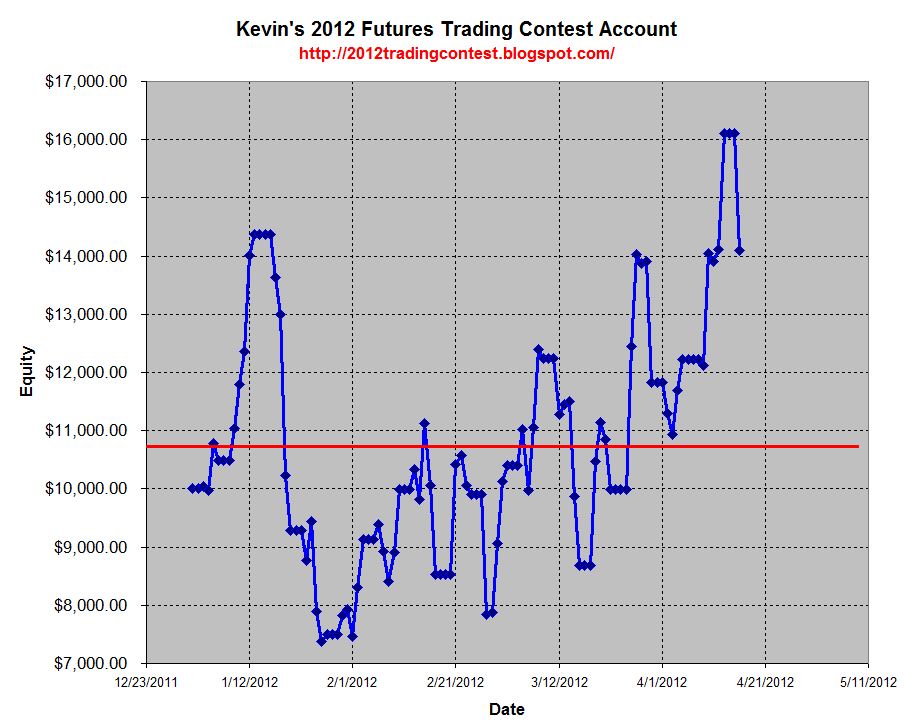
After 4 months, my contest account is doing fairly well, around +42% or so for the year. I had predicted around 150% per year, so at this point I'm a little behind the 50% return I had hoped for. But, I'm sure the 8% difference is within the error bounds of my calculations... : )
You might wonder why I decided to trade this particular system. What research did I do to show it would be good?
Basically, I came up with an idea, and just ran it through the data. No optimization (although I did look at some different stop levels and profit targets, my initial "hunch" for values were near optimum, so I changed nothing).
This wasn't your typical run of the mill Tradestation optimization. It took me a solid 2 weeks of testing, both in Tradestation and in Excel.
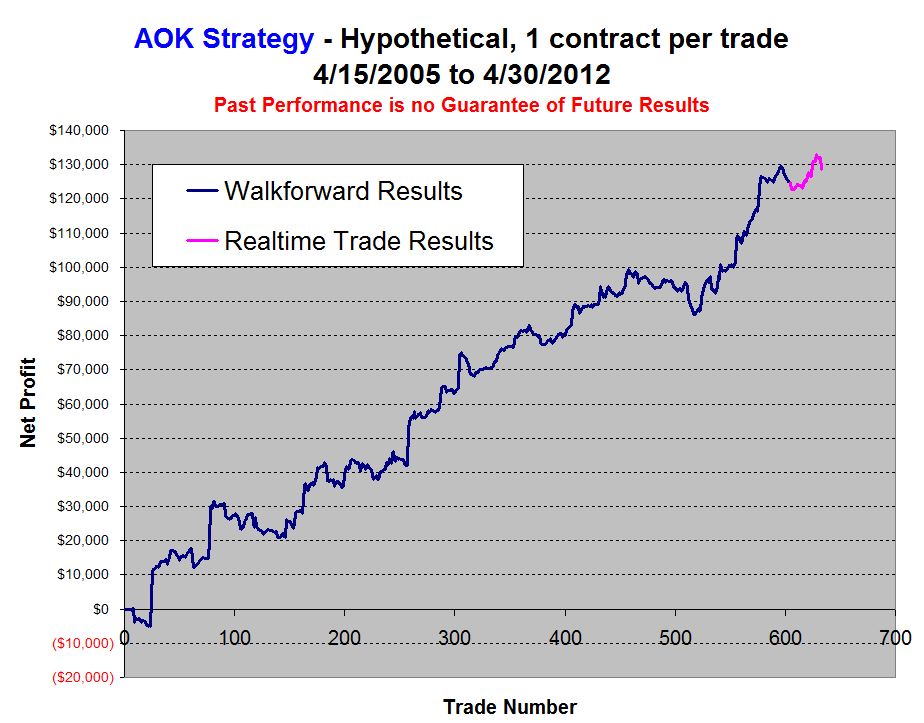
The graph below says it all. It shows the walkforward and real time (both hypothetical) results for this system, assuming 1 contract per trade.
What I like about this system/ why I decided to trade it:
1) Nearly 7 years of historical trade results, all walkforward tested (not your traditional backtest). If you don;t know why I like walkforward testing about 1,000 times as much as backtesting, just go to my website and look at my articles.
2) Approximately $200 average profit per trade, even after commissions and slippage (Side Note: I assume $50 round trip commissions and slippage. In reality thru April, it is more like $29. So, that "juices" performance by 10% or so. I get this through working and timing the orders a bit).
3) Steadily increasing equity curve. It looks good, but is not without its faults. It looks "real" to me, which is what I look for.
I'm curious what others think out there. If these were your research results, would you trade this system?
Formerly "Trading In A Futures Contest - 2012" - My trading journey - a mechanical trader trying to make a discretionary approach succeed.
Monday, April 30, 2012
Friday, April 27, 2012
Holding Steady, Continued
Contest
Wow. Not much change since Monday. Kind of nice. I'm still hovering around 48%. Only 4 positions open, although 2 are highly correlated, and another is a double position.
As promised, here is another installment in "The Trading Process"
****************************************************************
The Trading Process - Rate of Return
As part of your Trading Plan, you really need to know where you want to go. By this I mean "what rate of return on your trading capital do you want?"
It is not enough to say "I want to get rich trading." You really have to quantify it, for 2 good reasons.
First, you want to make it real. In goal setting, a statement like "I want to earn 50% per year" is much better than "I wanna be rich."
Second, with a written number, you'll have a target to measure your strategies against. Do the strategies meet your goals, or not?
So, Step 2 is "Determine Your Desired Rate of Return."
EXAMPLE: I did exactly this as part of developing a system for this trading contest. In my case, I wanted a rate of return that could win the contest.
So, first I went back and looked at previous winners (http://www.worldcupadvisor.com/worldcupchampionships/default_nwcc2.aspx, click on "See Full List" under Previous Winners section). Based on previous winners, I estimated that 100-150% annual return would probably put me in the top 3, and possibly in the top spot overall. That became my goal.
Consequently, for this contest, I decided to build a trading strategy that had a reasonably good chance of returning 100-150% in a year's time. If I found a strategy that returned 50%, I set it aside, since it did not meet my goal.
Of course, the flipside to the rate of return is also important. I'll talk about that next time.
Wednesday, April 25, 2012
Tuesday, April 24, 2012
The Trading Process
Contest Update:
I am up around 48% for the year (equity graph at the very bottom). That should put me back into the standings. If so, maybe I can actually stay there a while! My contest account has not been very consistent, to say the least!
http://www.worldcupadvisor.com/worldcupchampionships/default_nwcc2.aspx
*************************************************************
Since I don't show charts of my entries (because as I mentioned earlier, I don't use charts to make my trading decisions), I thought it might be useful for my esteemed readers to at least understand the process I used to create this contest trading strategy.
So, starting today, and maybe once or twice a week (hint: the more feedback I get on this, the more encouraged I will be to add more posts!), I'll walk you through the steps I used to develop this system. There are some things I did specifically because this was a contest system, so keep that in mind when you develop your own strategy. Hopefully you'll find value in this series of posts.
DEVELOPING A TRADING SYSTEM
Today we will start at the beginning. To succeed in any trading activity, you must HAVE A PLAN.
Sounds simple, right? You'd be amazed, though, at how many people don't have a plan for trading. Instead, they have some vague ideas of buying and selling something, and very specific ideas about how much money they'll make doing it. That "shoot form the hip" mentality almost never works.
So, step 1 is to HAVE A TRADING PLAN.
Some people will tell you that you need a 200 page, written plan. One that you refer to and consult with everyday. Well, that might work for some people, but not for me!
I keep things as simple as possible. Occam's Razor is a concept I always keep in mind.
(As an aside, you can read about my trading philosophy in a section I wrote for Brent Penfold's book "The Universal Principles of Successful Trading: Essential Knowledge for All Traders in All Markets (Wiley Trading)" http://www.amazon.com/The-Universal-Principles-Successful-Trading )
A Trading Plan should have everything you think you need, and nothing more. Of course, too little detail is not good, so there are some things that should be in your plan, at a minimum.
In the next installment, I'll list some of the important things a Trading Plan should have.
Comments and questions are encouraged!
Saturday, April 21, 2012
Where's The Stop, Dude?
Contest:
I am back up to +30% for the contest.
My friend Kurt is in 1st Place now. He is a great and CALM trader. Everyone better watch out!
http://www.worldcupadvisor.com/worldcupchampionships/default_nwcc2.aspx
******************************************
One positive trading day all week. Four losing days. Yuck. But there is always next week...
You still might be puzzled by the large loss I had earlier this week from a 1 lot. Over $3,000.
You might be wondering "Hey dumba**, why didn't you have a stop?"
Good question!
Here is an answer:
It is always good to have a stop loss point. For most people, having a firm stop loss order in the market is the only way to go. "Mental" stops - the ones where you tell yourself you'll get out when price hits the stop point - work only for very disciplined traders.
I use hard stop losses quite a bit. Here is a screenshot of some of the ones I have going right now (these are not in the contest acct).
So, that is Option A: Have a firm stop loss order entered at all times. (most people should stick to this)
I also use some other types of stops:
Option B: Exit next bar next bar Open if loss at close exceeds stop level (mental stop)
Option C: Exit next bar next bar Close if loss at current bar close exceeds stop level (mental stop)
Option D: No stop
For the contest, I am using Option C. With the particular way I am trading, I found that waiting a while (until the next close) after my stop was "hit" on average made the loss smaller.
So, I do have a "stop loss" point, but it is not typical. It leaves me exposed to market action like I had this week.
C'est la vie.
Wednesday, April 18, 2012
Exited the Big Loser
Down a little bit today...
You might wonder "what in the world happened?" since my equity high of last Friday, and the big celebration I had over the weekend for entering the Top 5 in the contest standings.
Well, 80% of the loss these past 3 days was one position of 1 contract. See the chart below.
Obviously, the risk incurred was way out of line for the account size. But, that is almost always the case for small accounts - the risk for even a 1 lot futures contract may be too much for most accounts.
The bright side of all this is that I followed the plan, and the system.
Acknowledge, and move on.
(By the way, there was no celebration over the weekend. The only day I would celebrate is on December 31st, after contest results were in, and after I made Pigs in a Blanket for about 30 people to eat on New Year's Day!)
Uncertainty
One really tough part about being a trader is dealing with the uncertainty. What will happen tomorrow? More of the same, or a turnaround? My current performance is a good example...
Two trading days ago, I was at a new equity high. Over 60% return for the year. Pretty good.
Now, I am looking at a 2 day drawdown of around 25%. Not so good.
If I knew tomorrow would bring a recovery, I'd probably not give it a second thought.
But, what if tomorrow is bad, just like the last 2 days? The thought of it is unsettling, to say the least. Watching profits vaporize is painful. Crowing about entering the top 5, and then falling out 2 days later, is downright embarassing, too!
At the end of the year, I won't even remember this particular day (except for the blog post). But right now, it is easy for this to be my focus.
Will I, and when will I, recover to a new equity high? The uncertainty of it all can be a killer.
Trading is emotionally gut wrenching. Don't let anyone tell you otherwise. It does get easier over time (10 years ago a 2 day, 25% drawdown would probably have me puking until I was doing dry heaves!), but the pain of losing (and joy of winning) is always there to some extent.
Tuesday, April 17, 2012
Why No Charts of Trades?
Based on a comment I made in a previous thread about other blogs, and showing trading charts, I thought I'd clarify something.
For this contest system, I do NOT look at current charts at all.
It doesn't matter to me if the current 1 minute/5 minute/60 minute/daily/weekly/monthly chart is an uptrend, downtrend or sideways trend.
It doesn't matter to me if the price is above/below moving average/MACD/trendlines.
It doesn't matter to me if support and resistance lines exist, and it doesn't matter where they are.
It doesn't matter to me if the market is overbought/oversold (whatever those terms really mean - most people don't know, except in retrospect).
I use those sorts of things on other systems I trade, but not for this system.
That is why you won't see any trading charts to explain my entries. I may show some charts now and then, to explain other aspects of my strategy.
Saturday, April 14, 2012
New Equity High
Hello Kevin Davey -
Welcome back to the Top 5 Standings. Feel free to stay a little longer this time!
Sincerely -
World Cup Futures Trading Contest
http://www.worldcupadvisor.com/worldcupchampionships/default_nwcc2.aspx
P.S. Remember, you are only #4. Barely. Hanging onto it by a thread. And it is a long contest.
Tuesday, April 10, 2012
Almost a New High
OK! Kind of ironic that on the same day I make a blog post titled "Boy am I an Awful Trader" I get very close to hitting a new equity high...long overdue, I might add...
Let's hope this trend continues!
Just to summarize my current situation. I am in 6 positions right now:
1 Big Loser
1 Little Loser
2 Little Winners
2 Big Winners (where I've doubled my position)
I see some potential new trades later in the week, but for now I'll just hopefully keep riding the winners.
Subscribe to:
Posts (Atom)